Aniruddha Marathe
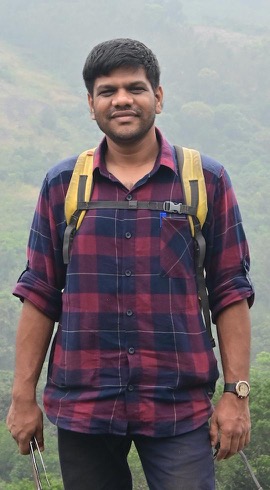
Aniruddha Marathe
email | CV | linkedIn | Github
Hello! My name is Aniruddha Marathe, and I am a quantitative ecologist. I am exited about the processes that drive community assembly and species diversity across environmental gradients. I am happiest when studying biodiversity patterns of ants, but frogs, trees and birds are also exiting. I have followed these interests to work on ants in the Himalaya, and frogs in the Western Ghats, India.
Species distributions in the Western Ghats
Impacts of climate change on frogs and lizards in the Western Ghats
Using a 10-year dataset with 4049 occurrence records of frogs from eight families and 27 genera as well as 733 occurrences of lizards from two families and 11 genera across the Western Ghats, we built SDMs to assess the changes in species distributions due to climate change. As expected, the temperature gradient across elevation and seasonality gradient across latitude contribute most to the climatic limits of species distributions. Latitudinal extents of most species were narrower in future predictions compared to the present, but there was little shift in latitudinal positions. On the other hand, most species shifted their distributions towards higher elevations, but the elevational range sizes remained the same. A total of 75 species of frogs (55%) and 15 species of lizards (45%) lose more than half of the suitable area, with few exceptions in both taxa that show an increase. Read more about it here: https://www.biorxiv.org/content/10.1101/2025.04.10.648234v1
map
time series plot
NDVI map
NDVI difference between 2025 and 2000 in Peninsular India. The map shows browning in urban centers, stable vegetation in protected landscapes of Wwestern and Eastern Ghats.